Kiewarra drought
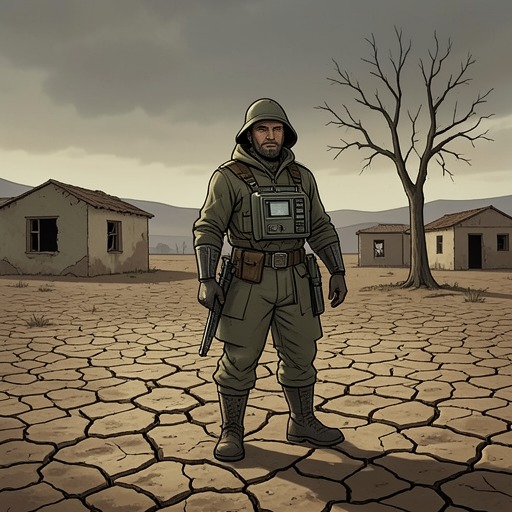
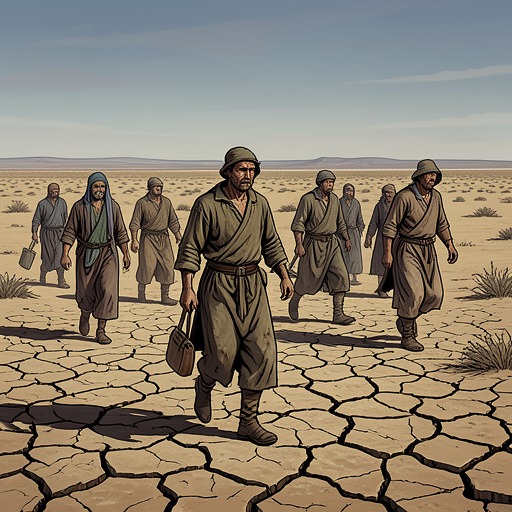
The DryKiewarra drought is the material crisis behind much of the town’s daily life: without rain, farms lose feed and water, livestock suffer, and the people who depend on the land face mounting economic and social pressure. It is more than a backdrop to the Hadler investigation. Its effects reach from the fields to the school and the town’s public spaces, while extreme fire warnings turn environmental hardship into an immediate threat to the whole community. Even as summer begins to fade, the river remains dry and relief is uncertain.
Conditions and Rural Livelihoods
The drought is introduced through its consequences for animals and farmers. With no rain there is no feed, and the livestock are thin; farmers face difficult decisions about how to sustain them. Flies gather around the animals, while the town sits beneath repeated days of burning blue sky. This opening view makes scarcity a practical and visible condition, not an abstraction: the weather determines what farms can provide and what their owners can afford to keep doing.
The pressure of farming also sharpens the contrast between rural and urban livelihoods in Aaron Falk’s reflections. He recognizes that his own work, despite the daily commute and long hours under office lights, does not depend on the whim of the weather. In Kiewarra, by contrast, prolonged dry conditions can push people toward fear and despair. This contrast helps explain the vulnerability of local farmers without reducing their choices to the drought alone: it is a force that narrows their options, not a universal explanation for every action.
The town’s dependence on land gives the drought a complicated economic horizon. David McMurdo explains that Mal Deacon’s farm may be valuable because of interest from Asian investment groups, and that the drought will not last forever. The prospect of future value exists alongside immediate hardship. A farm can be imagined as a substantial windfall even while the conditions of the present make rural livelihoods precarious.
Economic Pressure and Community Relations
The drought’s effects are felt in public debate as well as on individual farms. At the church, a community member argues that government decisions and threatened subsidy cuts have worsened the conditions in which farmers are trying to feed the country. Speaking in the wake of the Hadler family deaths, he invokes the severity of the weather as part of the wider crisis and suggests that the circumstances complicate judgment of Luke Hadler. His remarks do not establish the drought as a cause of the deaths; they show instead how material hardship enters the community’s attempt to interpret them.
The strain also intersects with older disputes. Barb Hadler recalls that, after a confrontation with Mal Deacon, an upper field on the family farm died and soil tests showed abnormal acidity. She suspects that chemicals applied by a neighbor could have caused such damage, but Gerry Hadler stresses that there was no proof that Deacon was responsible. The family lost thousands of dollars, struggled to remain afloat, and never fully recovered the field. The account reveals a farming community where financial loss can persist long after a particular episode, while uncertainty about responsibility makes direct accusation risky.
Gerry further explains why that uncertainty can endure. Farmers and other residents need one another to get by; Mal Deacon did business with many people, allowed some payments to slide, and accumulated favors that could give him influence. Falling out with him could make both business and ordinary social life in town harder. The drought is not presented as the origin of this local code of caution, but scarcity gives such interdependence added weight: when livelihoods are already vulnerable, challenging a powerful neighbor carries a practical cost.
Public Resources and Uneven Expectations
The shortage reaches beyond farms into the town’s ability to support its children. At Centenary Park, newly planted, drought-friendly cacti make the flower beds look unusually lush to Aaron Falk, yet the carefully chosen plants also register how local public space has adapted to water scarcity. Gretchen Schoner explains that the community has little money available for children because government funding goes toward farming subsidies. The school cannot ask parents for more, leaving its principal, Scott Whitlam, with limited means despite his apparent concern for the school.
That allocation of scarce funds places competing needs side by side: assistance for farming and support for children are both important, but the town has little capacity to provide for both. The disparity also unsettles the ideal of country life that can attract people from the city. Aaron Falk reflects that newcomers may imagine clean air, close neighbors, homegrown vegetables, and an honest day’s work; the quiet and the apparently wholesome landscape can look appealing from a traffic jam or a small apartment. Kiewarra’s drought exposes the limits of that ideal by making water, money, and the survival of a farm unavoidable conditions of rural life.
The drought also appears in the background of Scott Whitlam’s financial crisis, though the evidence distinguishes environmental pressure from his decisions. Whitlam describes being threatened by Melbourne creditors while his wife, Sandra Whitlam, and daughter were at home. He then decides to divert fifty thousand dollars from an education grant, disguising the allocation as a vague program so he can buy time to address his debt. The town’s limited resources and dependence on outside funds form the setting for this act, but his choice to misuse the money is his own. The episode makes the fragility of local institutions concrete: money intended for education becomes entangled with private debt and the threat of coercion.
Fire Danger and Collective Exposure
As the dry conditions persist, fire warnings mark an escalation in risk. When Aaron Falk first passes a roadside warning sign, the level has been severe since his arrival; later, on the drive toward the cemetery, it has risen to extreme. On another occasion, after Mal Deacon leaves, Falk waits five minutes before following the route to Deacon’s farm, and the warning remains at extreme. These repeated signs turn the drought into a changing hazard that accompanies ordinary journeys and investigative work.
The danger is not theoretical to Falk. He remembers a summer when a controlled burn escaped, costing a neighbor a home and forty sheep. Falk and his father tried to help with hoses and buckets as the sky darkened, and the experience remains a measure against which he judges the present. The land is drier now, so he understands that a new fire would not be a slow or manageable burn. This memory gives the warnings a personal and practical meaning without making them merely atmospheric.
During the bushland crisis, search-and-rescue crews assemble shoulder to shoulder along a track while wind drives dust and grit through the area. Kiewarra lies behind them, shimmering in the heat. Aaron Falk calculates the danger to the town, the school, livestock, and named residents, including Barb and Gerry Hadler, Gretchen Schoner, Rita Raco, Charlotte Hadler, and David McMurdo. He considers distances, homes, and escape routes, and concludes that fire could outrun a car, let alone someone on foot. The drought has made the danger collective: exposure is not confined to the person closest to the fire but extends across a town with limited time to get clear.
Persistence and Narrative Significance
The drought also shapes how Aaron Falk understands Kiewarra. At one point he imagines the town in three dimensions, climbing toward the lookout until the scene below grows smaller. From that imagined height, he sees the town, the drought, and the Hadlers within a different perspective. The dry conditions are part of the landscape through which he reconsiders the case, not a solution to its mysteries. The juxtaposition instead emphasizes how private loss and community life occupy the same pressured environment.
By the time Falk reaches the rock tree near the end, it is nearly April and summer’s intensity is fading. People say the drought might break in winter, and he hopes they are right, but the river is still gone. His hope is therefore deliberately conditional: the season may change, yet the central sign of water’s absence has not. Kiewarra drought remains unresolved at the close, linking the town’s precarious livelihoods, strained resources, and exposure to fire to an environmental crisis whose end cannot yet be assumed.